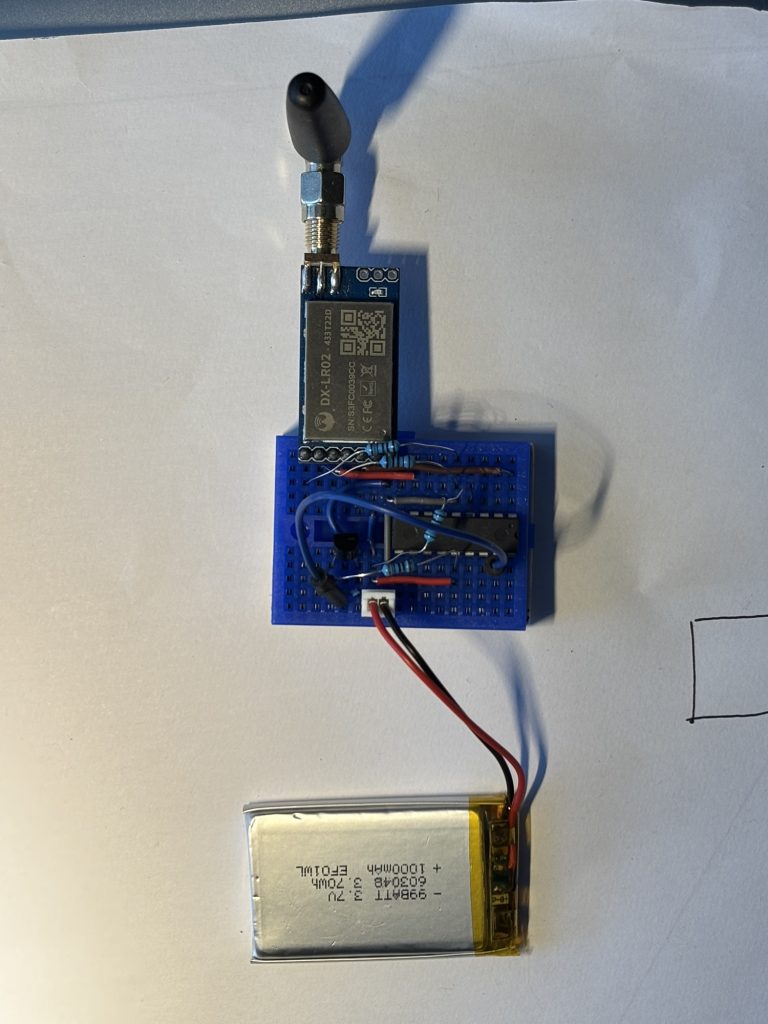
TINY-Therm V3.0. The worlds smallest 10km range temperature data logger. View the temperature from anywhere in the World from your phone/ computer/ tablet online! Just requires a quick Things-Speak account registration (free to setup and use for life).
View the full demo of it working here:
Get 3 million logs per year for free! It updates the temperature every minute. Battery life of this is up to 2 years continuously! Uses one simple long life Li-Po battery.
No wifi credentials are stored on the device so your passwords are safe! Perfect to use for instance as a garden greenhouse temperature sensing monitor. This is a digital download item only. Nothing will be sent in the post. Upon purchase you will receive the code to flash to your own device. This is a DIY thermometer where you build it yourself. This helps us keep the costs down. The full tutorial on how to build this in 10 minutes can be found here:
Temperature range is currently 0-99 degrees Celsius but I will be updating the project where it will measure -125 to 125 Celsius
So without further ado, let’s get straight to the design files and tutorial on how to build this within 10 minutes!…
🔗 The Build Process – Design Files & Tutorial
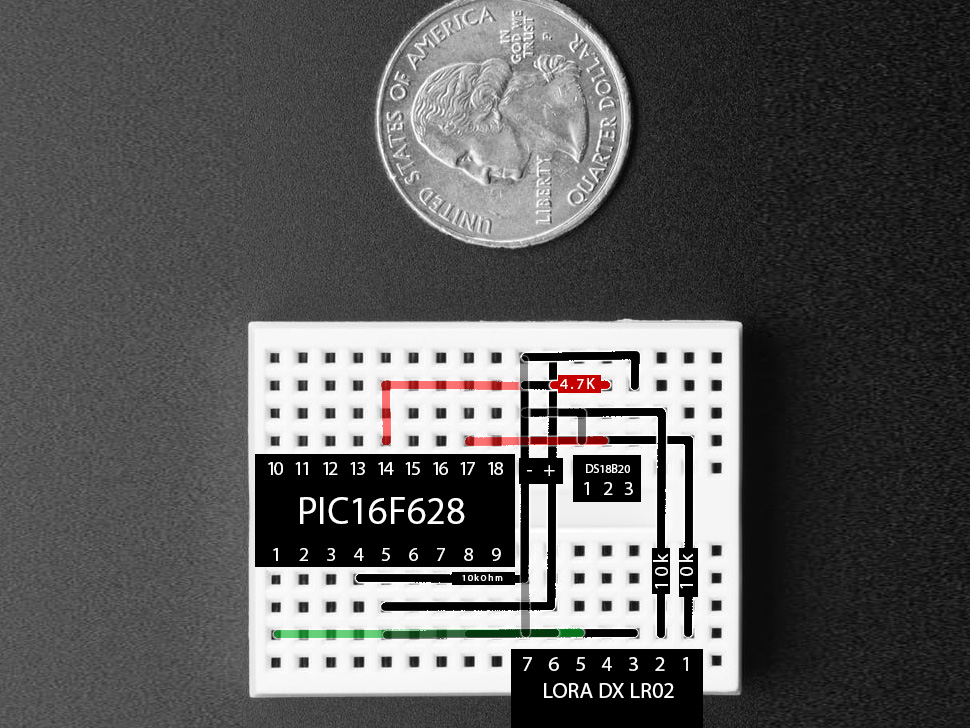
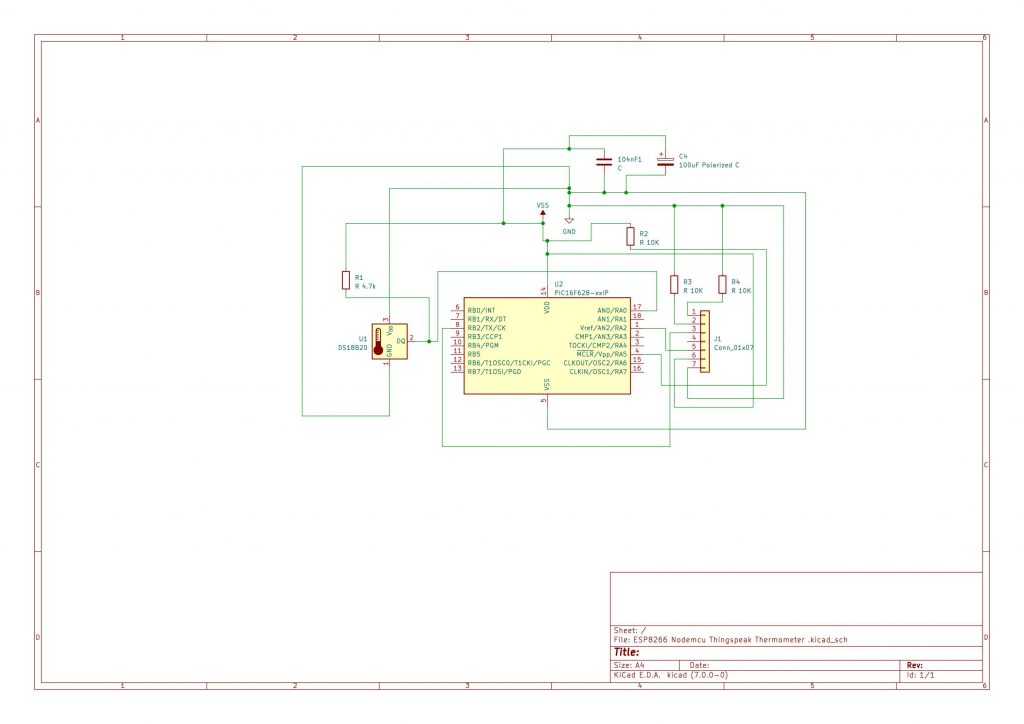
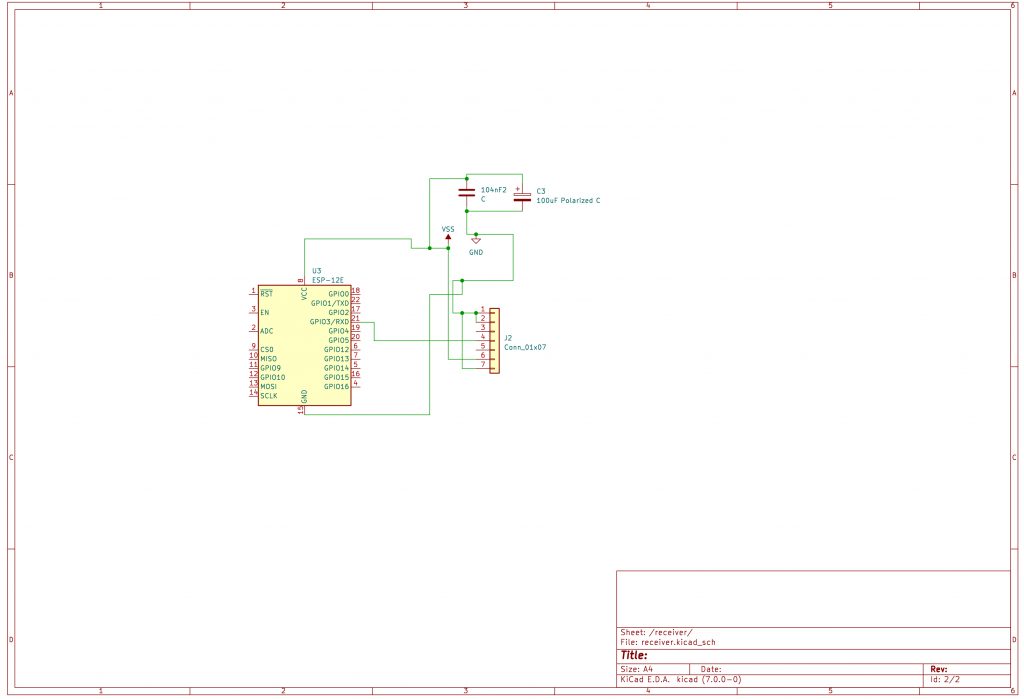
You can assemble this project using a breadboard or prototype setup by following the schematics below. Then flash the PIC and ESP8266 with the code provided and you’re good to go! Or if you want a more permanent solution, you can download this pcb gerber file and upload it direct onto jlcpcb.com, they will send you 5 of these boards for just £3 ready to solder yourself.
⚙️ Setup Summary
Bill of Materials Components list, all of which can be purchased for dirt cheap from AliExpress, see the buy links below (total roughly £20):
- 104nF ceramic capacitor
- 100 uF electrolytic capacitor
- Pre-flashed PIC16F628.
- DS18B20 Temperature Thermistor Sensor
- Resistors per the schematic (sold as an assortment).
- Lora DX LR02 transmitter receiver pair
- Nodemcu 12E (CH340 version) by ESP8266
- 2x Mini Breadboard if you want to have a permanent small footprint without committing to a soldered pcb.
- Micro USB DATA Cable to flash the Nodemcu
software needed:
Steps to build this:
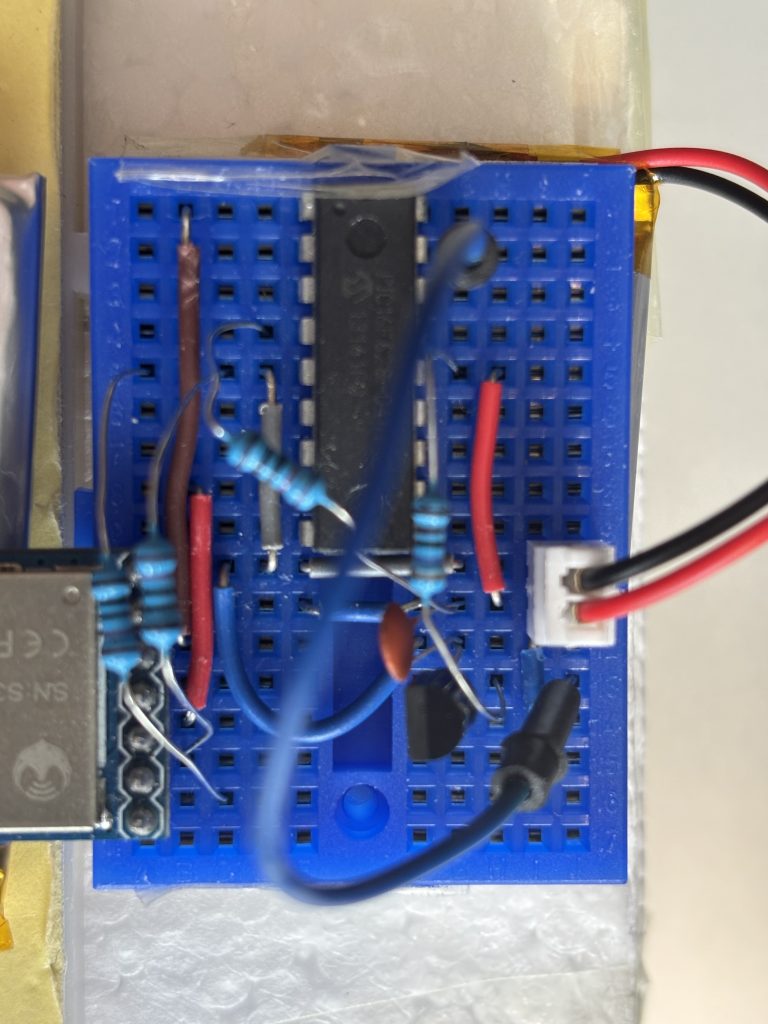
- Assemble the components onto the mini breadboards per the image below and schematics, or
- Solder on the components (see below for how to get the pcb made).
- Create a ThingSpeak account and download the Arduino IDE
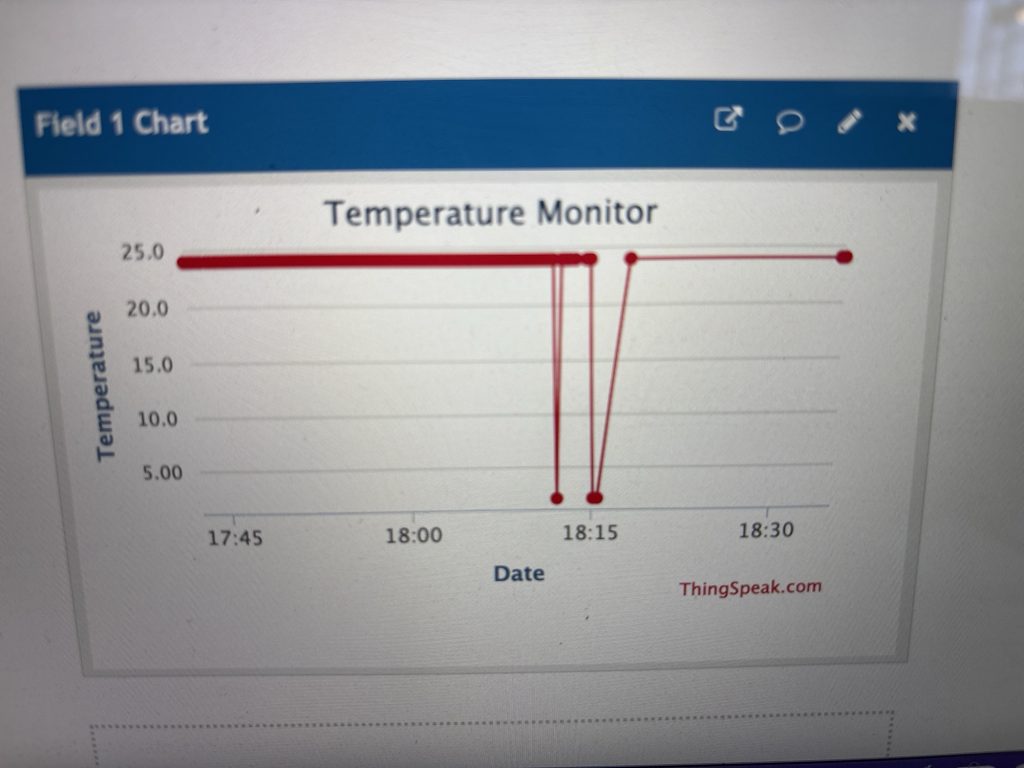
- In Thingspeak, create a new channel and enable Field 1 (Temperature)
- Make a note of the Channel ID and API Key generated
- Copy and paste this Sketch code to your Arduino IDE and choose ESP Nodemcu 12E as the board. Fill in your WiFi user/password + Channel ID + Channel API Key where shown in the code.
- Upload the Arduino sketch to your NodeMCU (tutorials are online on how to do this).
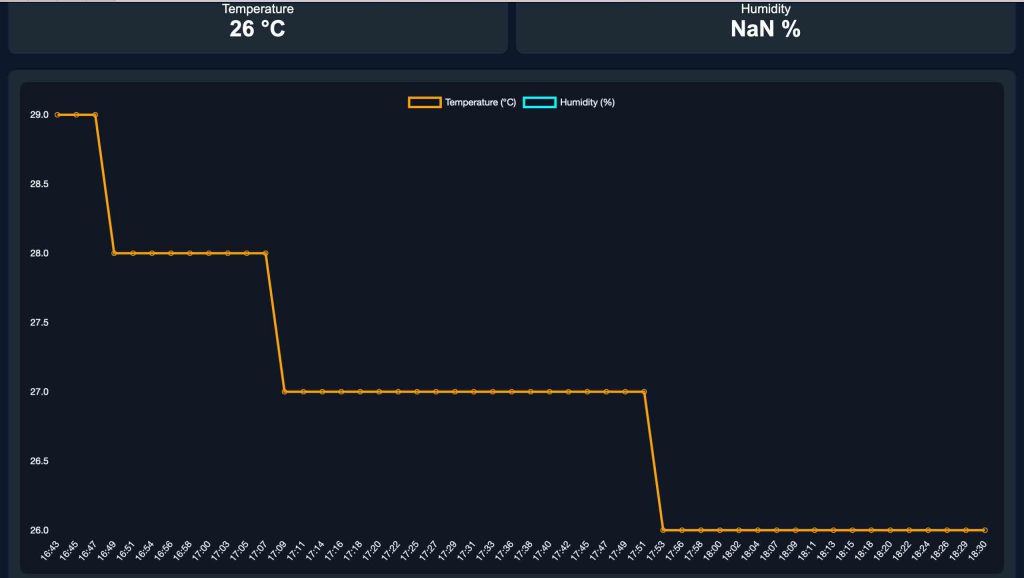
- Power the receiver unit on first and wait 20 seconds before powering on the transmitter unit. And that’s it, the devices are now logging temperature data. You can view all the updated temperatures every minute using your Thingspeak dashboard. You can also use this makeshift dashboard I made also:
Transmitter Schematic
Build the Transmitter on a mini breadboard like this!…
Receiver Schematic
PCB Manufacture: If you want to solder the components onto a pre manufactured board, simply get your board following this guide, you get 5 for roughly £3:
- Download the gerber file:
2. Get JLCPCB to print the circuit board. You get 5 x for just £2 delivered worldwide on the cheapest delivery option. That means 5 temperature loggers if you so wish. Upload this Gerber file on their order page and keep all the settings at default. Continue to checkout and choose the cheapest delivery option, unless of course you want it faster.
And that’s it, enjoy!
Disclaimer Notice: This is an educational tutorial only and I will not accept any responsibility for damage or harm to property and/or persons as a result of you following and building this tutorial project. You are responsible for your own safety and performing any safety tests if used commercially. Ideally we recommend this for use only in personal/hobby projects.
This is an educational tutorial for personal use only. Commercial use of this project is strictly prohibited. You must ensure you conduct the appropriate safety tests once you have made this. I will accept no liability for any death, injury, harm or damage to humans/property or animals as a result of you following this tutorial.
This is an untested project. This is for hobby and personal use only. We do not allow commercial use of this tutorial (ie selling it in an end product, but if you are making this for commercial purposes, YOU are responsible for all CE, FCC and safety testing according to your jurisdiction. We will not be held responsible for any fire, damage or injury caused by this project.
Personal Liscense (Commercial use prohibited)
You are free to use this for personal and educational use. You are prohibited from using this for commercial use. You are also prohibited from redistributing the content, code, schematics and images on this webpage as is or modified. Failure to comply with this will result in legal action. Creative Commons License applies to this.
TINY-Therm V3 Wireless Temperature Logger by ODONO DESIGN (DigitBox) © 2026 by Patrick O’Donoghue is licensed under CC BY-NC-ND 4.0


For those interested in this projects background and details, you can read below, or just build it as above and get temperature logging. Enjoy!
📡 Overview
In this project, we build a long-range wireless temperature monitoring system using LoRa radio communication (10km range), a PIC microcontroller, and a NodeMCU ESP8266. See the demo of it working here. Includes a free html webpage dashboard (see dark blue image above) that can be saved locally which means it doesn’t need to be stored on a web server, just open up the html file on your desktop or phone and it will display the temperature data for you for the last 24 hours along with the current temperature.
The beauty of this design is that the Lora module and PIC microcontroller update the temperature once per minute, and in between this both put themselves into sleep mode, meaning one battery will last over a year of continuous use and data transmissions!
The system allows you to monitor temperature from remote locations such as a garden, shed, greenhouse, or outdoor enclosure afar ( up to 10km away) — and view live data anywhere in the world using the ThingSpeak wifi cloud platform.
Unlike typical WiFi-based sensors, this system does not require WiFi credentials to be stored on the outdoor sensor device, making it significantly more secure (no need to store wifi username and passwords directly on the ESP8266 which can be accessed by anybody outside) and much higher range to remotely monitor areas up to 10km away from your wifi router at your home/office. Due to the Lora transmitter, you are no longer locked to keeping the temperature sensor 10 metres in proximity to your wifi router (like the inferior Tapo system), as this system doesn’t rely on wifi to transmit the temperature data. Using Lora opens for this part of the interface opens up a whole load of new possibilities.
How to build this yourself?
If you want to skip the blurb on what this does and how it does it, please scroll down to the “The Build Process – Tutorial” section to get to the nitty gritty part of how to build this yourself DIY style! All the components will be a total maximum of £15 depending on the AliExpress market prices. A Full BOM list and purchase links are also included in the tutorial below. This is extremely cheap considering professional market temperature loggers are priced upwards of £200!
The How
🧠 System Architecture
The project is split into two main parts:
[ Sensor Node (Outdoor) ]
PIC16F628 → DS18B20 Temperature Sensor → LoRa Transmitter
↓
Wireless Long-Range Link (LoRa)
↓
[ Base Station (Indoor) ]
LoRa Receiver → NodeMCU ESP8266 → ThingSpeak Cloud
🌍 How It Works
1. Sensor Node (Outdoor Unit)
The outdoor unit is built around a PIC16F628 microcontroller connected to a DS18B20 temperature sensor.
The PIC reads temperature data and formats it ready for transmission.
- I.e: 24 = temperature value (°C)
This data is transmitted via LoRa every 5 minutes, then both the pic microcontroller and lora go to sleep before the next transmission, thus conserving battery power.
2. Receiver Node (Indoor Unit)
The base station uses a NodeMCU ESP8266 connected to a LoRa receiver module. This is powered using a usb cable and left on indefinitely.
It:
- Receives incoming LoRa packets
- Extracts the temperature value
- Validates and processes the data
Once decoded, the value is passed to the WiFi stage.
3. Cloud Upload (ThingSpeak IoT)
The NodeMCU uploads the processed temperature value to ThingSpeak, allowing:
- Real-time graphs
- Historical data logging
- Remote access from any device with internet
No custom app is required — just open your ThingSpeak channel in a browser on you phone, desktop or smart tablet (i.e iPad).
📊 ThingSpeak Dashboard
ThingSpeak provides:
- Live updating temperature graph
- Automatic data logging
- Mobile and desktop access
- Long-term data storage (ideal for monitoring trends)
Once configured, the system continuously logs sensor data at your chosen interval.
⚡ Power & Efficiency Design
To make the system suitable for outdoor battery operation:
- PIC microcontroller sleeps between transmissions
- LoRa module remains inactive when not sending data
- System wakes periodically to transmit readings
This approach significantly reduces power consumption and allows long-term battery operation.
🧩 Key Features
- Long-range wireless communication using LoRa
- No WiFi required at the sensor node
- Secure remote sensing (no exposed credentials outdoors)
- Cloud-based monitoring via ThingSpeak
- Low-power design for battery operation
- Simple and reliable packet protocol (TxxE)
- Easily expandable to multiple sensor types
🔧 Possible Upgrades
This system can be expanded to include:
- Humidity monitoring
- Soil moisture sensing
- Battery voltage tracking
- Multi-node sensor networks
- Alerts via ThingSpeak webhooks or email
💡 Why This System Is Useful
Most off-the-shelf IoT sensors rely entirely on WiFi, which limits range to a typical home network and requires storing credentials on the device.
This design solves that problem:
- The sensor node does not store WiFi credentials
- Communication range is significantly extended using LoRa
- The system can operate in remote outdoor environments
- Data is still accessible globally via the cloud
🏗️ Hardware Overview
Sensor Node:
- DS18B20 temperature sensor
- PIC16F628 microcontroller
- LoRa transmitter module
Base Station:
- LoRa receiver module
- NodeMCU ESP8266 (ESP-12E)
- WiFi connection to ThingSpeak
🚀 Real-World Applications
A temperature data logger like this is widely used in:
- Cold chain logistics
- Pharmaceutical storage monitoring
- Food safety (HACCP compliance)
- Laboratory temperature mapping
- HVAC system optimisation
- Agricultural and greenhouse monitoring
What is a temperature logger?
A temperature data logger is a portable device used to automatically measure and record environmental temperatures over a specific period. It ensures that sensitive goods remain within safe limits by providing a reliable, automated alternative to manual thermometer checks.
They are essential tools across various industries, fulfilling the following primary uses:
- Cold Chain Shipment Monitoring: Tracking perishable goods (e.g., produce, dairy) and pharmaceuticals in transit to guarantee that conditions remain within safe parameters.
- Pharmaceutical and Vaccine Storage: Ensuring drugs, blood samples, and vaccines are kept at required temperatures (e.g., +2°C to +8°C) to prevent spoilage and maintain their efficacy.
- Food Safety and HACCP Compliance: Monitoring refrigerators, freezers, and processing facilities to ensure strict food safety regulations are continuously met.
- Laboratory and Equipment Mapping: Performing temperature mapping in scientific environments, incubators, or industrial ovens to identify hot and cold spots.
- Building Management & HVAC: Optimizing climate control systems in commercial and agricultural buildings for efficiency and product quality.
📌 Final Notes
This project demonstrates how low-cost embedded systems can be combined to create a long-range IoT monitoring solution without relying on WiFi at the sensor location.
By combining:
- PIC microcontroller processing
- LoRa long-range communication
- ESP8266 cloud connectivity
…you get a flexible, scalable remote monitoring system that can be deployed almost anywhere.